
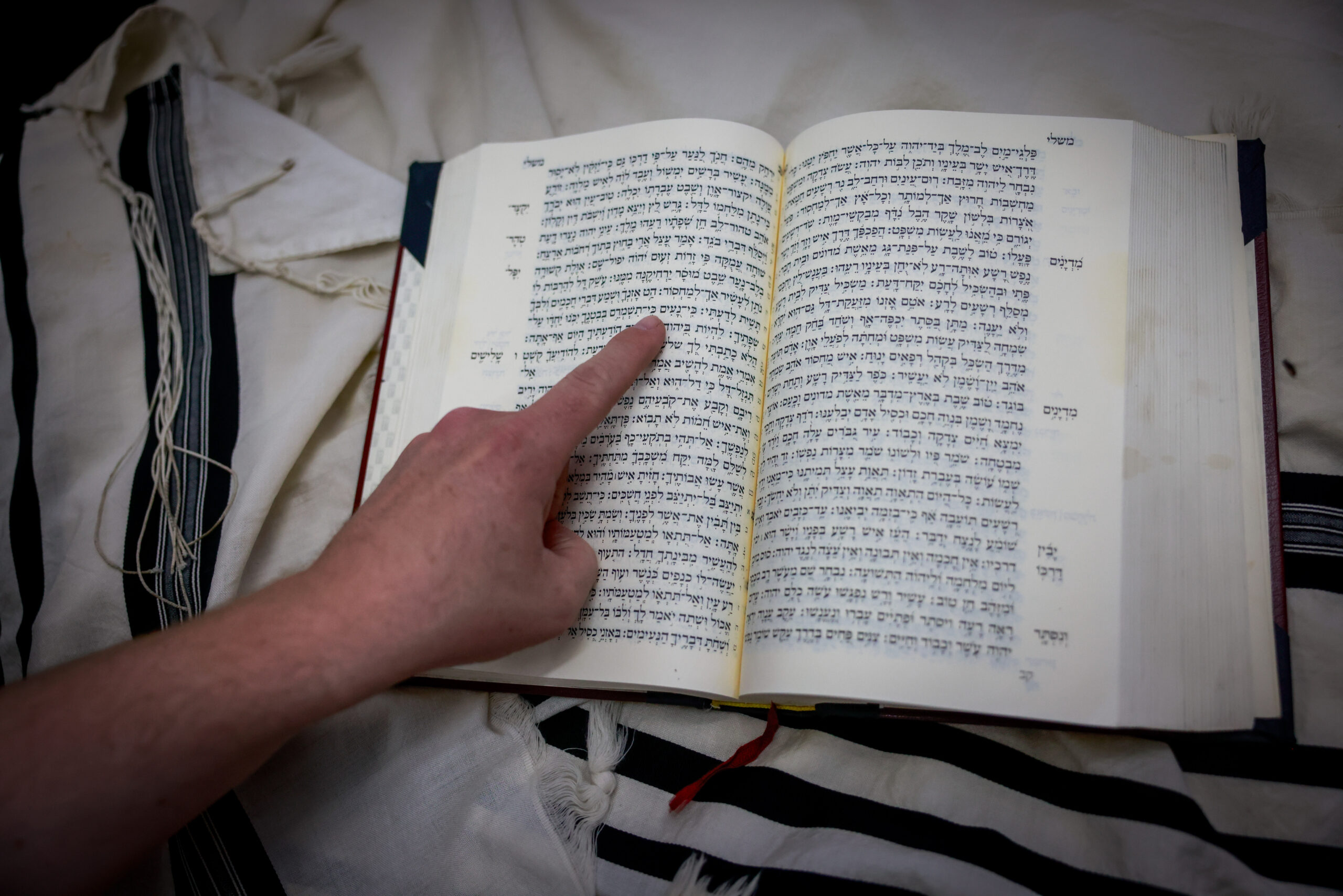
When people debated Charlie Kirk on Israel, they almost always wanted to argue the political points. International law. Borders. Territories. Israel versus Palestine. But Charlie believed the topic of Israel begins with the Bible.
For a man of such deep and outspoken faith, biblical prophecy—not geopolitics—was the foundation of his view on Israel. To Charlie, the dispersion of the Jewish people and their eventual return to the land of Israel was spelled out, plainly, in Scripture.
As he once told a college student:
“There’s a biblical prophecy that talks about Israel being spread across all the nations. And [in] normative evangelical theology, which I believe in, we believe that the creation of the state of Israel in the 1940s was a fulfillment of that prophecy.”
When asked at the Oxford Union whether the modern State of Israel fulfills biblical prophecy, Charlie was candid about his limits—and just as clear about his position.
“I’m not a theologian,” he said. “But I am definitely more aligned with a view of Ezekiel 36—that there is a reconstitution of the state of Israel and that was prophesied: ‘I will bring you from across the lands and graft you together.’”
His point becomes clear when you look at the text itself. Ezekiel 36:24 says, “For I will take you from among the nations and gather you from all the countries, and I will bring you to your land.” Similarly, Isaiah 11:12 echoes the same promise: “He will raise a banner for the nations and gather the exiles of Israel; He will assemble the scattered people of Judah from the four quarters of the earth.” Jeremiah 31:10 says it too: “He who scattered Israel will gather them and will watch over his flock like a shepherd.”
And then there’s Deuteronomy 30:3–5, which reads like a roadmap:
“Then the Lord your God will restore your fortunes and have compassion on you and gather you again from all the nations where He scattered you. Even if you have been banished to the most distant land under the heavens, from there the Lord your God will gather you and bring you back. He will bring you to the land that belonged to your ancestors, and you will take possession of it.”
Charlie never pretended these questions were settled across Christianity. He openly acknowledged that Catholic theology—and much of Reformed theology—teaches that Israel becomes the Church in the New Testament. He spoke respectfully of that view and even pointed out that his wife was baptized Catholic.
But ultimately, for him, the return of the Jewish people to the land of Israel wasn’t incidental. It was meaningful—and part of God’s master plan.
“The view I’m sympathetic towards,” he said, “is that the scriptures are very prophetic towards a literal and direct meaning and that the nation and the reconstitution of the nation of Israel actually have a place in God’s plan for us on this planet. It’s not metaphorical. It’s a literal [manifestation] of God’s plan.”
That belief also explains something critics often misunderstood: Charlie’s support for Israel was not tied to the Israeli government, with which he disagreed on several occasions. His support for Israel wasn’t rooted in policy. It was rooted in Scripture—particularly Scripture’s exhortations to support the Jewish people.
The Bible links how people treat the Jewish people with blessing or judgment. In Genesis 12:3, God tells Abraham, “I will bless those who bless you, and whoever curses you I will curse.”
In the New Testament, Paul emphasizes that the people of Israel were entrusted with “the divine glory, the covenants, the receiving of the law, the temple worship and the promises,” and that “from them is traced the human ancestry of the Messiah” (Romans 9:4–5). Romans 11:1–2 asks plainly, “Did God reject his people? By no means!” Jesus himself says in John 4:22, “Salvation is from the Jews.”
For Charlie, this wasn’t abstract theology. It has practical implications for Christians today.
“I believe that Paul said in the New Testament we must bless the Jews,” he said. And he tied that belief directly to Jesus: “I believe that our own Lord and Savior, when we go up and we see the Lord of Lords and the King of Kings, we’re going to see a rabbinic rabbi by the name of Jesus Christ sitting on the throne. He was a Torah observant, Shabbat-observant Jew.”
That framing mattered. Christianity, in Charlie’s view, didn’t replace Judaism—it emerged from it. And that conviction led him to a simple conclusion.
“Here’s the thing. We just have a difference of opinion,” he said. “I think we have an obligation to the Jews as Christians.”
You don’t have to agree with Charlie Kirk to understand his argument. He wasn’t claiming theological infallibility. He wasn’t saying Israel is beyond criticism. He was saying that if Scripture is read plainly and literally, the return of Jewish sovereignty to the land of Israel is not an accident of history but part of God’s unfolding plan—and that deserves our support.
LINKS