
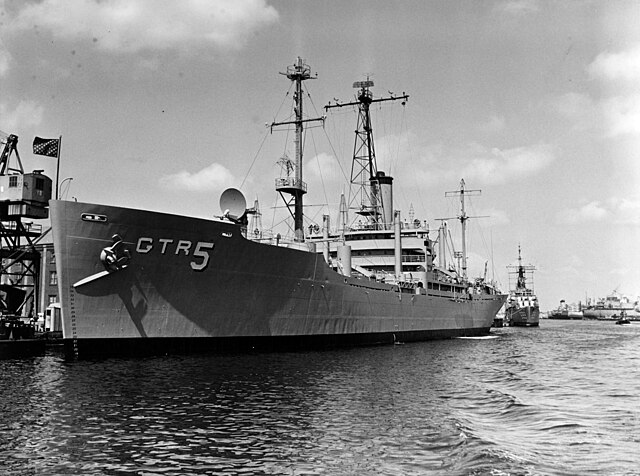
The Lie
- Israel deliberately attacked the U.S. Navy intelligence ship USS Liberty in 1967.
The Truth
- Multiple U.S. and Israeli investigations concluded that the incident was a tragic case of mistaken identity amid the chaos of the Six-Day War — not a deliberate attack on the United States.
Background
- On June 8, 1967, the USS Liberty was operating in international waters north of the Sinai Peninsula during the Six-Day War between Israel and hostile Arab countries.
- Based on mistaken reports and misidentification of the vessel, Israeli forces attacked the ship with cannon fire, rockets, napalm, and torpedoes, Thirty-four American crew members were killed and roughly 170 wounded.
- Once Israeli commanders realized the vessel was American, they immediately stopped the attack and offered medical assistance. Israel formally apologized to the United States and paid compensation to the families of the dead, the wounded, and for damage to the ship.
Truth Explained:
- The Israel Defense Forces (IDF) believed the USS Liberty to be a hostile vessel based on erroneous battlefield reports and several factors, including operational errors by the USS Liberty. (CIA report), (US Navy)
- Israeli pilots failed to identify the vessel as American but immediately called off the attack once they did. (US Navy), (CIA report), (Clifford Report)
- Israel promptly notified the U.S. Embassy, offered rescue assistance, and issued formal apologies. (Office of the Historian)
- Israel paid $3.32 million ($28.4 million today) to families of the deceased and $3.57 million for medical costs and lost wages ($31.57 million today). In 1980, it paid $6 million ($23.6 million today) for ship damages. (NSA)
- Multiple U.S. government investigations — including inquiries by the Navy, CIA, NSA, Joint Chiefs of Staff, and Congress — found no evidence that Israel knowingly attacked a ship it recognized as American. (Liberty Incident), (Naval Court of Inquiry), (CIA), (Joint Chiefs of Staff), (US Senate), (Clifford Report), (US Navy), (House Armed Services Committee)
- Three separate Israeli investigations independently concluded the attack was unintentional. (Liberty Incident)
- The NSA declassified recordings of Israeli pilots communicating after the strike that reveal their confusion and misidentification of the ship as the Egyptian transport ship El Quseir. (NSA), (NSA)
- None of the accusations alleging a deliberate Israeli attack have articulated a credible motive. One theory suggested Israel intended to blame Egypt — yet Israel never attempted to do so and instead immediately accepted responsibility. (CBS News)
- Another theory claims Israel attacked the Liberty to conceal plans to seize the Golan Heights. However, Israel’s defense leadership had already informed U.S. officials of that intent prior to the attack. (Naval History and Heritage Command)
- Friendly-fire incidents are an unfortunate reality of war. During the Gulf War, for example, nine of the 24 British soldiers killed died as a result of mistaken U.S. attacks despite survivors’ accusations that friendly markings were visible. (New York Times)
- James Ennes, a former Liberty crew member and leading proponent of the deliberate-attack claim, has repeatedly advanced extreme pro-Arab narratives, calling his neutrality into question. (CAMERA)
Quotes:
- “In the summer of 1967 the Israeli leadership considered American goodwill towards Israel to be its supreme political interest, second only to Israel’s existence.” — Captain/Judge A. Jay Cristol, lead historian of the Liberty Incident
- “Although the Liberty is some 200 feet longer than the Egyptian transport El Quesir, it could easily be mistaken for the latter vessel by an overzealous pilot. Both ships have similar hulls and arrangements of masts and stack.” — CIA report
Takeaway:
The USS Liberty incident was a horrific tragedy. The evidence points to a cascade of wartime failures — faulty intelligence, miscommunication, misidentification, and human error — compounded by the chaos of a fast-moving regional war.
Claims of a deliberate attack persist largely because the event was traumatic, investigations were imperfect, and the conclusions are politically inconvenient. But no credible motive, no documented proof, and no corroborated intelligence has ever emerged to support the accusation of intent.