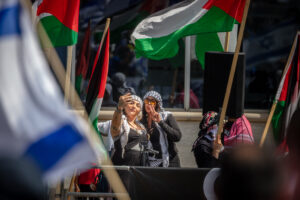
A claim circulating again in pro-Palestinian media insists that Arab Muslims in British Mandatory Palestine welcomed Jewish refugees into their homes after World War II. The statement was most recently repeated on December 17, 2025, when activist Nadine Ayoub told Piers Morgan Uncensored that “after WWII, we Palestinians took Jews into our homes.” Similar assertions have been promoted by figures such as Mohamed Hadid.
The historical record tells a very different story.
There is no evidence that Palestinian Arabs broadly welcomed or sheltered Jewish refugees after the Holocaust. In fact, Jewish immigration to Palestine was actively obstructed, and Jewish communities faced violence, political opposition, and detention rather than hospitality.
Well before World War II ended, Arab leaders in Palestine pressured Britain to sharply restrict Jewish immigration and land purchases. That pressure culminated in the 1939 White Paper, which effectively closed the gates of Palestine to Jews fleeing Nazi Europe. Hundreds of thousands of Jews who might have escaped were denied entry and later murdered by the Nazis. This policy was not imposed against Arab wishes. It was demanded by Arab leadership.
At the center of that leadership stood Haj Amin al-Husseini, the Grand Mufti of Jerusalem and the most prominent Palestinian Arab figure of the era. Al-Husseini openly collaborated with Nazi Germany, meeting with Adolf Hitler and senior Nazi officials. He worked to block Jewish rescue efforts and fought Jewish immigration to Palestine throughout the war years. Historical records show that he even sought a Nazi-Arab alliance aimed at exterminating Jews beyond Europe, extending into the Middle East.
This was not an abstract ideological conflict. Jewish communities in Palestine faced repeated and deadly violence during the British Mandate period. Arab attacks on Jews included the 1929 massacres and the sustained campaign of terror during the 1936–1939 Arab Revolt, in which hundreds of Jews were murdered. These attacks were systematic and ongoing, not isolated incidents. Jewish self-defense organizations such as the Haganah, Irgun, and Lehi emerged as a response to this violence, not as instruments of aggression.
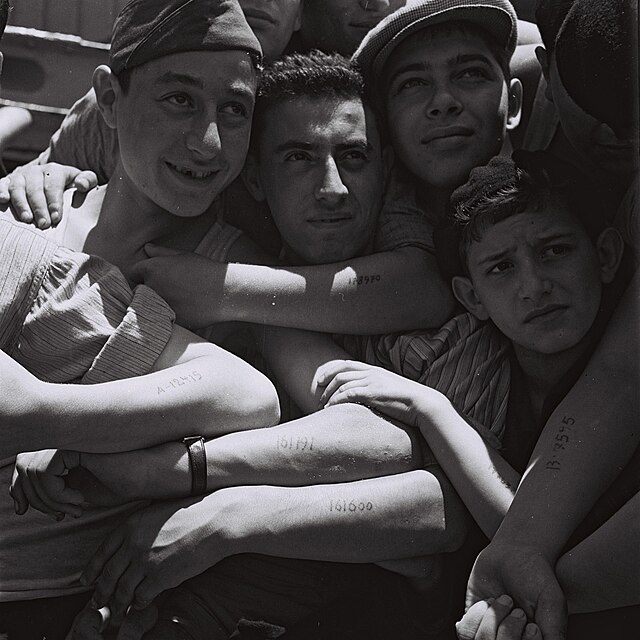
By the time World War II ended, the idea that Jews arrived en masse with nowhere to go and were taken in by Arab families is historically incoherent. By 1939, more than 450,000 Jews already lived in Palestine. There was no postwar wave of Jewish refugees being housed by Palestinian households. Those Jews who did manage to reach Palestine after the war were not welcomed into Arab homes. They were detained by British authorities in camps, labeled “illegal immigrants,” and often deported or imprisoned.
Violence did not subside after the Holocaust. In 1947, the United Nations proposed a partition plan to create separate Jewish and Arab states. Jewish leaders accepted the plan. Arab militias rejected it and launched attacks on Jewish civilians and neighborhoods, setting the stage for full-scale war.
Contemporary claims of Arab hospitality toward Jewish refugees also clash starkly with the rhetoric of the period. In 1944, Haj Amin al-Husseini called on Arabs to murder Jews, declaring, “Arabs! Rise as one and fight for your sacred rights. Kill the Jews wherever you find them. This pleases God, history, and religion. This saves your honor. God is with you.” Three years later, Arab League Secretary-General Azzam Pasha warned that the coming conflict would be “a war of extermination and momentous massacre which will be spoken of like the Tartar massacre or the Crusader wars.”
Even British investigative bodies at the time rejected the narrative that Jewish immigration overwhelmed the country or displaced Arab society. The Peel Commission noted in 1937 that “the heavy immigration in the years 1933–36 would seem to show that the Jews have been able to enlarge the absorptive capacity of the country for Jews.”
The takeaway is clear. The claim that Palestinians sheltered Jewish refugees after World War II is a modern political myth. The documented history shows obstruction of Jewish rescue, collaboration with Nazi Germany, organized violence against Jewish civilians, and postwar detention of Holocaust survivors. What Jews encountered in British Mandatory Palestine was not refuge or generosity, but hostility and resistance, even in the shadow of the Holocaust.