
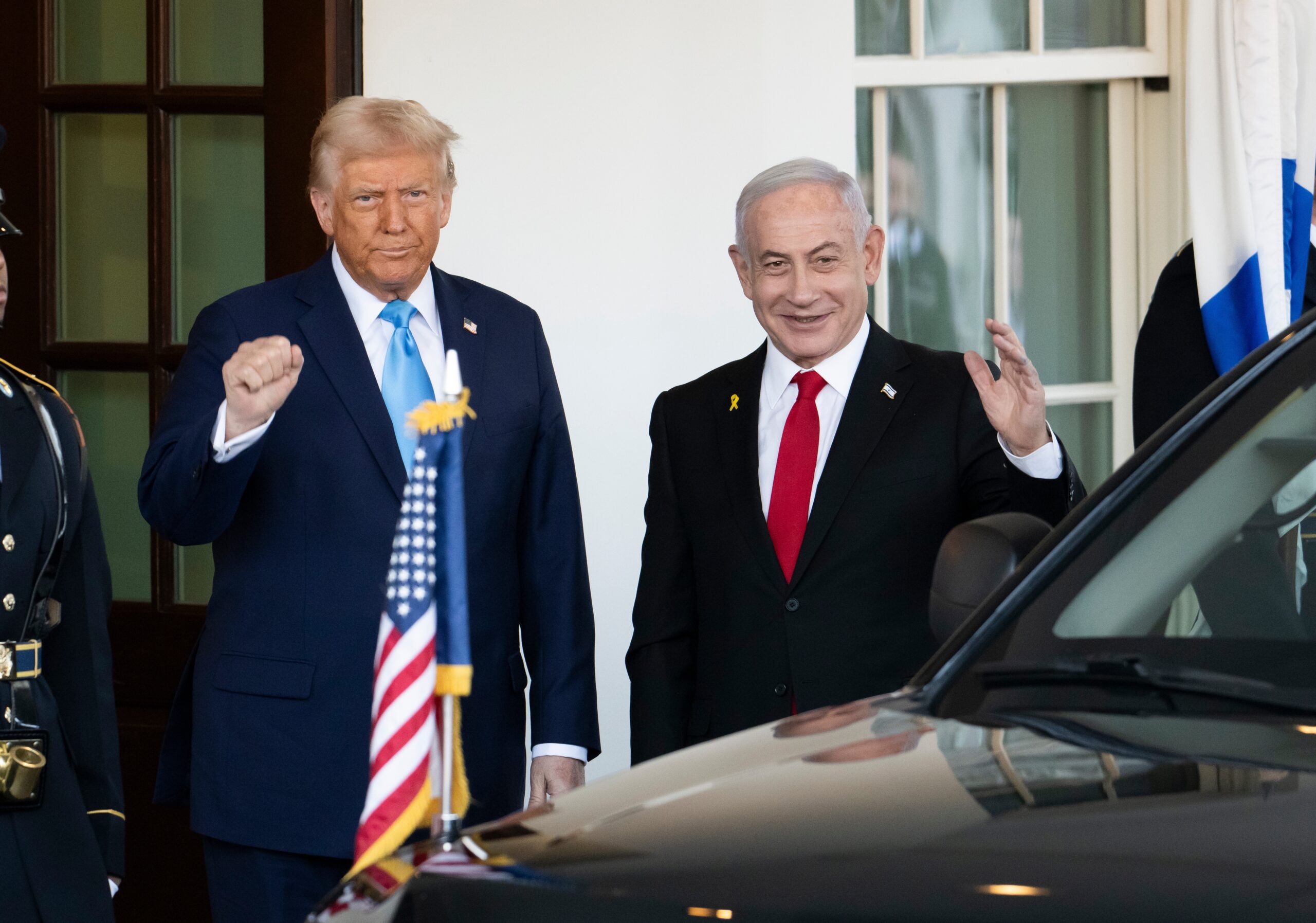
Claims circulating online that Donald Trump broke historic precedent by siding with an Arab country over Israel are inaccurate and misleading.
On December 7, 2025, conservative commentator Tucker Carlson posted on X that “no American president has ever sided with an Arab state over Israel until Donald Trump forced Bibi to apologize to Qatar.” The claim followed reports that, in September 2025, President Donald Trump pressured Israeli Prime Minister Benjamin Netanyahu to apologize to Qatar after missile strikes targeting Hamas officials in Doha.
Carlson’s assertion fits a broader narrative alleging that Israel has exerted outsized control over U.S. foreign policy for decades. However, the historical record shows that multiple U.S. presidents—across parties and generations—have repeatedly taken positions favoring Arab states or broader regional considerations over Israeli objections.
A Pattern Across Administrations
From Israel’s founding onward, U.S. policy has often diverged from Israeli preferences. The United States imposed an arms embargo on Israel from 1948 until 1962. During that period, Israel requested weapons from Presidents Harry Truman, Dwight D. Eisenhower, and John F. Kennedy, and was refused.
Eisenhower went further during the 1956 Suez Crisis, demanding that Israel withdraw from Arab territory. In a letter to Israel’s prime minister that year, Eisenhower wrote:
“Statements attributed to your Government to the effect that Israel does not intend to withdraw from Egyptian territory, as requested by the United Nations, have been called to my attention. I must say frankly, Mr. Prime Minister, that the United States views these reports, if true, with deep concern.”
In the 1980s, President Ronald Reagan approved the sale of AWACS surveillance aircraft to Saudi Arabia despite strong Israeli opposition.
Presidents in later decades followed similar patterns. President George H. W. Bush withheld $10 billion in loan guarantees over Israeli settlement activity in Judea and Samaria. President Jimmy Carter drove the Camp David negotiations and pressured Israel to return the Sinai Peninsula to Egypt.
Years later, Carter sharply criticized Israel’s policies, writing in 2006:
“The pre-eminent obstacle to peace is Israel’s colonisation of Palestine. Israel’s occupation of Palestine has obstructed a comprehensive peace agreement in the Holy Land, regardless of whether Palestinians had no formalised government, one headed by Yasser Arafat or Mahmoud Abbas, or with Abbas as president and Hamas controlling the parliament and cabinet.”
Continued Pressure in the Modern Era
More recent administrations also clashed with Israeli leadership. President Bill Clinton repeatedly pressed Israel to make concessions during the Oslo process while overlooking Palestinian non-compliance, according to critics.
President George W. Bush advanced the “Roadmap for Peace,” which applied pressure on Israel regarding settlements and steps toward Palestinian statehood, even amid Israeli resistance.
Under President Barack Obama, the United States supported a United Nations resolution challenging Israeli claims to the Western Wall, pursued the Iran nuclear deal despite Israel’s objections, and demanded settlement freezes in an effort to placate Palestinian leaders.
The Bottom Line
Trump’s reported pressure on Israel regarding Qatar may be controversial, but it is not unprecedented. For decades, U.S. presidents have balanced alliances with Israel against broader regional interests, frequently pressuring Israeli governments or siding with Arab states on key policy questions.
The historical record makes one point clear: Donald Trump is not the first U.S. president to take positions opposed by Israel, nor does his alleged action mark a unique break from past American policy in the Middle East.