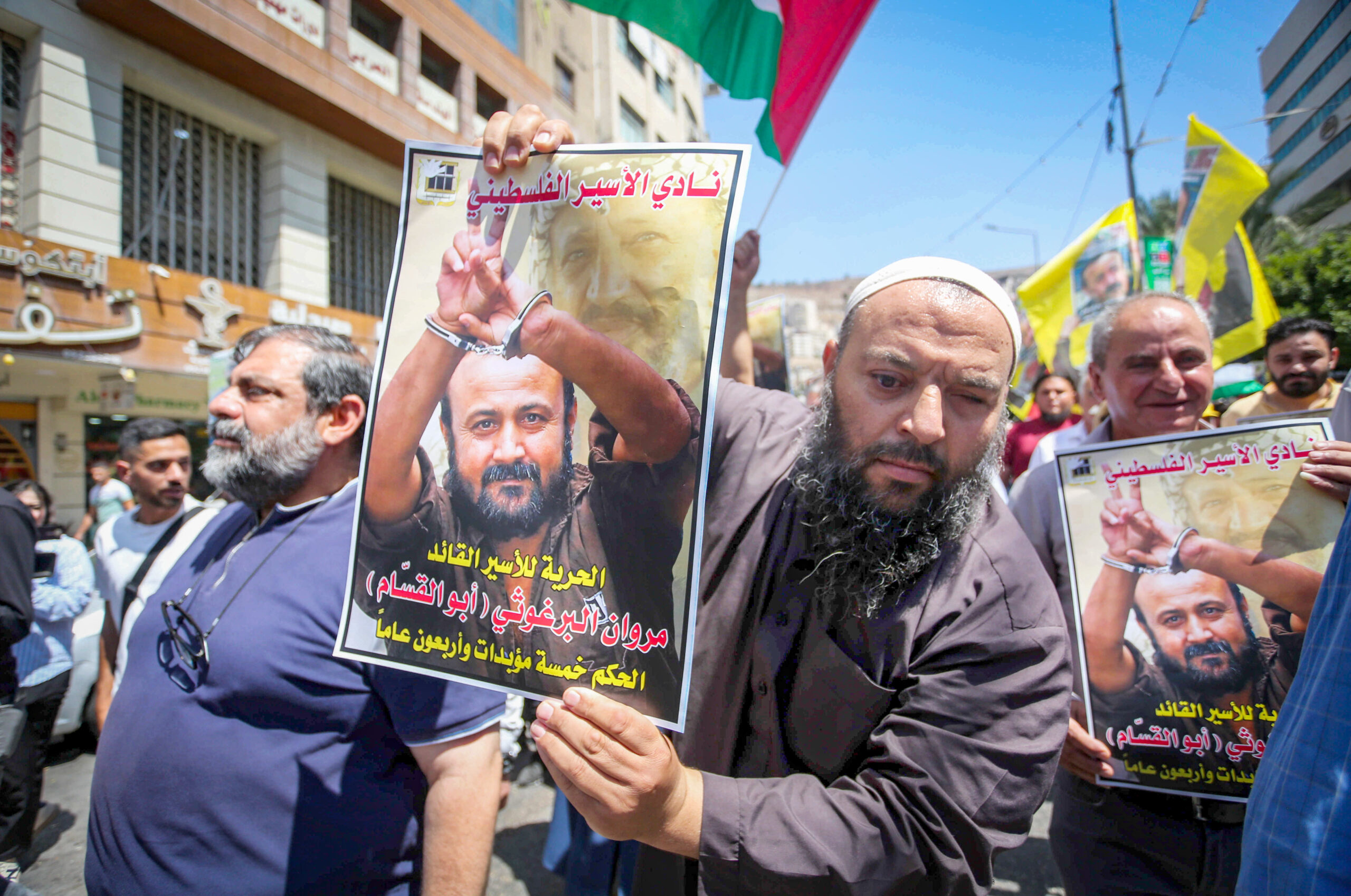
Marwan Barghouti, a senior Palestinian Authority official imprisoned in Israel for more than two decades, has been increasingly portrayed by activists and celebrities as a political prisoner and likened to Nelson Mandela. Supporters claim he is being unjustly detained and violently mistreated by Israeli authorities. The available record, however, tells a markedly different story.
Barghouti, 66, has been incarcerated in Israel for 23 years following his conviction in 2004 for murder, attempted murder, and directing terror operations against civilians. An Israeli court sentenced him to five life terms plus 40 additional years for his role in three separate attacks that killed five Israeli civilians.
On December 3, 2025, a group of 200 Western celebrities signed a public letter alleging that Barghouti had been subjected to “violent mistreatment” in prison and calling for his release. The letter, circulated by the Free Marwan Campaign, echoed claims amplified by figures including British politician George Galloway and former United Nations official Francesca Albanese, who described Barghouti as a “symbol of unity” and alleged he had been tortured by Israel.
Those claims stand in contrast to the findings that led to Barghouti’s conviction.
According to Israel’s Ministry of Foreign Affairs, Barghouti supplied weapons used in the June 12, 2001, murder of Father Tsibouktsakis Germanus, 35, who was shot near Jericho. On January 15, 2002, Yoela Hen, 45, was murdered while stopping for gas outside Jerusalem by terrorists acting on Barghouti’s orders. On March 5, 2002, three civilians were killed and more than 30 wounded in the Seafood Market suicide bombing in Tel Aviv, an attack Israeli authorities say Barghouti ordered and coordinated through the Al-Aqsa Martyrs’ Brigades.
Barghouti has also admitted to directing terror operations on behalf of Yasser Arafat, providing funding, weapons, and instructions to militants who carried out shootings and bombings, according to reporting cited from the Los Angeles Times and Aish. He founded Tanzim, Fatah’s armed faction, and later helped establish the Al-Aqsa Martyrs’ Brigades, which carried out numerous attacks against civilians during the Second Intifada.
In addition, Barghouti led the “Nationalist and Islamic Forces,” a coalition that coordinated Fatah and Islamist groups in conducting shootings and ambushes throughout the West Bank. According to the Jerusalem Center for Foreign Affairs, these campaigns were part of the Second Intifada, during which more than 1,000 Israeli civilians were murdered.
During his trial, Barghouti expressed no remorse. Upon entering the courtroom, he raised a victory sign and declared, “So long as occupation continues, the intifada will not stop.” He later stated, “As long as Palestinian mothers are weeping, Israeli mothers will also weep.” Barghouti boycotted his own trial and subsequently declared it illegitimate when proceedings continued in his absence.
Claims that Barghouti has been tortured in prison remain unverified. Allegations of broken ribs, teeth, and fingers originate solely from statements made by his son and have not been corroborated by independent evidence.
Despite this record, supporters continue to frame Barghouti as a Palestinian equivalent of Nelson Mandela. Israeli government spokesperson Eylon Levy has rejected that comparison, stating, “Marwan Barghouti is the ‘single-most admired Palestinian leader’ because he’s a serial killer, not despite it.”
Critics argue that portraying Barghouti as a political prisoner or peace symbol obscures the documented evidence of his role in orchestrating lethal terror attacks and erases the civilian victims of those crimes. The comparison to Mandela, they say, is not merely inaccurate but a deliberate distortion of history.